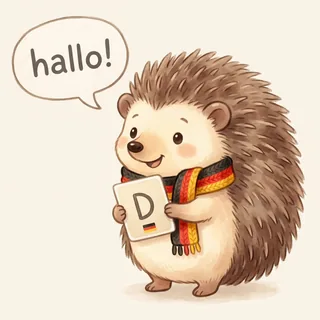
Look at the picture and say it in German before the other one does. Flip the card to check, and hear how it sounds.
Deine Runde
Themen ·
Spielart
Karten pro Runde
Hint on the front
Phrase cards always show a short cue, since a picture alone can't say "the bill, please".
Articles are colour-coded:derdiedasdie (plural)
Spieler & Stimme
Spieler
The names used for scores in Wettkampf, in every section.
Vorlesen
Hören uses this voice too. In conversations the second speaker gets the other recorded voice, or a lower one.
1 / 20
Tap or press Space to flipTap to flip
EN
ES
Cards to practise again
Grammatik
Fälle · Perfekt · Nebensätze · Konjunktiv
Read a short explanation, then fill the gaps in everyday sentences. Each answer shows why, and you can hear the sentence.
Deine Runde
Sätze pro Runde
Lektionen
Akkusativ & Dativ
German shows what a noun does in the sentence by changing its article: der Mann, den Mann, dem Mann. Ask the right question to find the case.
NominativWer? Was?The subject: who does it.
AkkusativWen? Was?The direct object: what the action is done to.
DativWem?The receiver: who gets it, or who it's done for.
The articles
der (m.)
die (f.)
das (n.)
die (Pl.)
Nom.
der ein
die eine
das ein
die –
Akk.
den einen
die eine
das ein
die –
Dat.
dem einem
der einer
dem einem
den (noun +n)
In the Akkusativ only the masculine changes: der → den, ein → einen.
In the Dativ every article changes, and plural nouns add -n: die Kinder → den Kindern.
kein, mein, dein, sein, ihr and unser take the same endings as ein: meinen Bruder, meiner Mutter, keinem Kind.
Pronouns
Nom.
Akk.
Dat.
ich
mich
mir
I, me
du
dich
dir
you
er
ihn
ihm
he, him
sie
sie
ihr
she, her
es
es
ihm
it
wir
uns
uns
we, us
ihr
euch
euch
you (all)
sie / Sie
sie / Sie
ihnen / Ihnen
they / you (formal)
Which verbs take which case?
Most verbs with an object take the Akkusativ: haben, brauchen, sehen, kaufen, nehmen, essen, trinken, kennen, besuchen, fragen, anrufen.
Some everyday verbs always take the Dativ: helfen, danken, gefallen, gehören, schmecken, passen, antworten, gratulieren, vertrauen, fehlen, zuhören, glauben (a person), stehen (to suit) and wehtun.
Verbs of giving take both: the person gets the Dativ, the thing the Akkusativ. geben, schenken, zeigen, bringen, schicken, schreiben, erklären, empfehlen, leihen.
mich or mir? With no other object it's mich; when there's also a thing or a body part it's mir.
Word order can change, the case can't: A few masculine nouns add -n outside the Nominativ: der Kollege → den Kollegen, der Patient → dem Patienten.
Fixed phrases with the Dativ:
Para hispanohablantes: gefallen works like gustar: me gusta → es gefällt mir. But fragen, anrufen and besuchen take the Akkusativ even where Spanish says le: le pregunto → ich frage ihn.
Präpositionen
After a preposition the case is set by the preposition itself. Learn them in three groups.
Always Akkusativdurch, für, gegen, ohne, um
Always Dativaus, bei, mit, nach, seit, von, zu (and ab, außer, gegenüber)„Aus, bei, mit, nach, seit, von, zu – fährst immer mit dem Dativ du!“
Wo or wohin?an, auf, hinter, in, neben, über, unter, vor, zwischenAkkusativ or Dativ, depending on the question.
Two-way prepositions: wohin or wo?
Wohin? Movement to a place → Akkusativ. Verbs: legen, stellen, setzen, hängen (to put).
Wo? Where something is → Dativ. Verbs: liegen, stehen, sitzen, hängen (to be).
Wohin? + Akk.
Wo? + Dat.
Short forms
an dem → am
an das → ans
in dem → im
in das → ins
zu dem → zum
zu der → zur
bei dem → beim
von dem → vom
Everyday uses
Places: nach Spanien, nach Berlin (countries and cities); zum Arzt, zur Arbeit; in die Stadt; bei meiner Mutter, bei Siemens.
Time: um acht Uhr; am Montag, am Abend; im Juli, im Sommer; seit zwei Jahren (and still now); vor einer Woche (a week ago); nach dem Essen (after); von neun bis fünf; ab Montag (from Monday on).
Going or being? zum Arzt / beim Arzt / vom Arzt; zu meiner Freundin / bei meiner Freundin. Countries with an article take in: in die Schweiz, in der Schweiz.
B1, with the Genitiv: wegen (because of), trotz (despite), während (during). In speech you'll also hear wegen dem Regen.
Verbs with a fixed preposition: warten auf + Akk., denken an + Akk., sich freuen auf + Akk. (look forward to), Angst haben vor + Dat.
More to learn as a pair: + Akk.: sich interessieren für, sich kümmern um, bitten um, sich ärgern über, sich beschweren über, sprechen über, sich erinnern an, sich gewöhnen an, Lust haben auf, stolz sein auf. + Dat.: sprechen mit, zufrieden sein mit, aufhören mit, teilnehmen an, fragen nach, träumen von, halten von, abhängen von, einladen zu.
Para hispanohablantes:esperar a alguien is warten auf, never für. Hace una semana is vor einer Woche, and desde hace dos años is seit zwei Jahren with the present tense.
Perfekt
When Germans talk about the past, they mostly use the Perfekt: haben or sein in second place, and the past participle at the very end.
habenMost verbsEvery verb with an object, and also schlafen, arbeiten, wohnen…
seinMovement and changeGoing from A to B or changing state, plus sein, bleiben, werden and passieren.
Satzklammer2nd place … endhaben or sein comes second, the participle goes last.
For sein, haben and the modal verbs, people usually say the short past (Präteritum) instead: ich war, ich hatte, ich konnte, ich musste.
fahren with an object takes haben: ich habe das Auto gefahren. Without one it's movement:
In a question the participle still goes last:
Reflexive verbs always take haben, even verbs of movement: ich bin gelaufen, but
A few verbs take sein although nothing seems to move: begegnen, ausfallen, vergehen.
Para hispanohablantes: the Perfekt looks like he comido, but Germans use it for any past event, also where Spanish uses the indefinido: ayer comí pizza → gestern habe ich Pizza gegessen. And unlike Spanish, verbs of movement take sein: fui a casa → ich bin nach Hause gegangen.
Trennbare Verben
Many everyday verbs start with a little word that splits off: aufstehen, anrufen, einkaufen. That prefix carries the stress: AUFstehen.
PresentVerb 2nd, prefix last
With a modalTogether at the endAfter müssen, können, wollen, möchten…
Perfektge- in the middle
Everyday separable verbs
Verb
English · Español
Perfekt
aufstehen
get up · levantarse
ist aufgestanden
anrufen
call · llamar
hat angerufen
einkaufen
shop · hacer la compra
hat eingekauft
anfangen
begin · empezar
hat angefangen
aufhören
stop · dejar de
hat aufgehört
ankommen
arrive · llegar
ist angekommen
abfahren
leave · salir
ist abgefahren
umsteigen
change trains · hacer transbordo
ist umgestiegen
mitkommen
come along · venir también
ist mitgekommen
abholen
pick up · recoger
hat abgeholt
einladen
invite · invitar
hat eingeladen
aufmachen / zumachen
open / close · abrir / cerrar
hat aufgemacht / zugemacht
fernsehen
watch TV · ver la tele
hat ferngesehen
umziehen
move house · mudarse
ist umgezogen
Separable or not?
Prefixes that are little words on their own split off: ab, an, auf, aus, ein, mit, nach, vor, weg, zu, zurück, fern.
be-, ver-, er-, ent-, emp- and zer- never split, and their Perfekt has no ge-: Nor does unterschreiben: Sie unterschreiben hier.
After weil, dass, wenn or wann the verb goes to the end and joins up again:
Para hispanohablantes: Spanish packs it all into one verb (me levanto), German keeps the prefix for the end of the sentence. Listen for it before you decide what the verb means: ich mache das Fenster auf or zu?
weil, dass, wenn, obwohl
To say why, what, when or although, German adds a second clause. After these little words the conjugated verb jumps to the very end.
Main clauseVerb 2nd
After weil, dass…Verb last
Clause firstVerb, then subjectThe whole clause counts as place one.
The words that send the verb to the end
Word
English · Español
Example
weil
because · porque
…, weil ich krank bin.
dass
that · que
Ich glaube, dass er recht hat.
wenn
if, whenever · si, cuando
Wenn es regnet, bleibe ich zu Hause.
als
when (once, in the past) · cuando
Als ich Kind war, …
obwohl
although · aunque
…, obwohl es teuer ist.
ob
whether · si
Ich weiß nicht, ob er kommt.
wann, wo, wie…
indirect questions
Weißt du, wann der Zug ankommt?
damit
so that · para que
…, damit du mich verstehst.
bevor, nachdem
before, after · antes de, después de
Bevor wir essen, …
während, bis, seit
while, until, since · mientras, hasta que, desde que
Warte, bis ich zurückkomme.
Watch out
With a modal or the Perfekt, the conjugated verb goes after everything else:
denn also means because, but it doesn't move the verb:
wenn, als or wann? Questions use wann; one time in the past is als; everything else is wenn.
deshalb (so, that's why) and trotzdem (anyway) don't send the verb to the end either: the verb comes straight after them.
Para hispanohablantes: Spanish si is two words in German: wenn for a condition (si llueve) and ob for whether (no sé si viene). And cuando is three: wann, wenn and als.
Präteritum
In speech Germans tell the past with the Perfekt, except for a handful of verbs: sein, haben, the modals and es gibt. Those almost always use the Präteritum.
seinwar
habenhatte
Modalsno umlaut + te
The forms
sein
haben
können
müssen
wollen
ich
war
hatte
konnte
musste
wollte
du
warst
hattest
konntest
musstest
wolltest
er/sie/es
war
hatte
konnte
musste
wollte
wir/sie/Sie
waren
hatten
konnten
mussten
wollten
ihr
wart
hattet
konntet
musstet
wolltet
In stories and the news
ich and er/sie/es have the same form: ich war, er war.
es gibt →
Regular verbs add -te: machen → machte, wohnen → wohnte. Irregular ones change the vowel: gehen → ging, kommen → kam, fahren → fuhr, treffen → traf. You'll mostly hear these in written texts, stories and on the radio.
Para hispanohablantes:war covers both era/estaba and fue/estuvo, and hatte both tenía and tuve. No need to choose between imperfecto and indefinido.
Höflich: hätte, könnte, würde
The Konjunktiv II makes requests polite, gives advice and talks about wishes and things that aren't true. You only need a few forms.
AskingKönnten Sie…?
AdviceAn deiner Stelle…
UnrealWenn ich… wäre
The forms
sein
haben
können
werden
sollen
ich / er / sie
wäre
hätte
könnte
würde
sollte
du
wärst
hättest
könntest
würdest
solltest
wir / sie / Sie
wären
hätten
könnten
würden
sollten
ihr
wärt
hättet
könntet
würdet
solltet
Making plans
Suggest a time:
Invite:
Check it suits:
Every other verb uses würde + infinitive at the end: ich würde gern kommen.
Advice: du solltest, an deiner Stelle würde ich…
About the past: hätte or wäre + participle.
Para hispanohablantes: it's the condicional and the imperfecto de subjuntivo in one: podría = könnte, si tuviera = wenn ich hätte. The umlaut matters: konnte is just the past, könnte is polite.
Komparativ & Superlativ
To compare, add -er and use als. For the most, use am …sten, or der/die/das …ste before a noun.
Sameso … wie
More…er als
Mostam …sten
Ones to learn by heart
Adjective
Komparativ
Superlativ
gut
besser
am besten
viel
mehr
am meisten
gern
lieber
am liebsten
hoch
höher
am höchsten
groß
größer
am größten
alt · jung
älter · jünger
am ältesten · am jüngsten
warm · kalt
wärmer · kälter
am wärmsten · am kältesten
teuer
teurer
am teuersten
Useful patterns
What you like best:
Before a noun the superlative takes an ending:
je … desto:
immer + comparative = more and more: Before a noun the comparative takes an ending too: eine größere Wohnung, etwas Billigeres.
Para hispanohablantes: no más in front: más rápido = schneller, el más rápido = am schnellsten. And que becomes als, never wie: schneller als.
Hören
Durchsagen · Anrufe · Gespräche · Führungen
Read the question, listen to an announcement, voicemail, conversation, interview or guided tour, and pick the right answer, like in the Goethe A2 and B1 listening test. Play it as often as you need.
Deine Runde
Texte
Spielart
Texte pro Runde
1 / 10
Text zeigenÜbersetzung
EN
ES
Listen to these again
Prüfung
Sprechen · Lesen · Schreiben
The other parts of the Goethe A2 and B1 exam: talk a task through together, read short texts and answer, or write an email and compare it with a model answer.
Aufgaben
Aufgabe
Wer bist du?
EN
ES
Look only at your own diary and find a free hour by talking.
Useful phrases
1 / 8
Übersetzung
EN
ES
EN
ES
Check your own email: did you answer all three points, start with a greeting (Liebe… / Sehr geehrte…) and end with one (Viele Grüße / Mit freundlichen Grüßen)?
1 / 10
Look at these again
Zwei Handys
Play on two phones at once: both see the same card or question, and whoever taps first gets to answer. Both phones need the internet to find each other.
Neues Spiel
Get a room code to give to the other phone.
Raumcode
Was spielen wir?
Uses the topics and round size picked in each section on this phone.